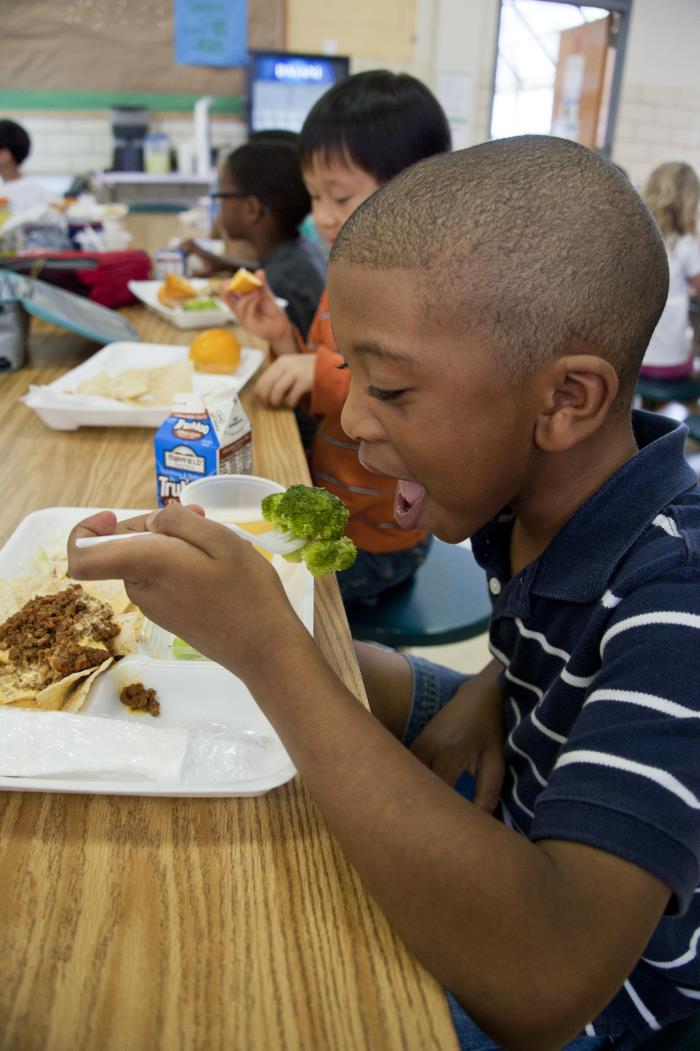
As many parents and school staff members can attest, a K-12 school is often the source of a lot of food waste. This can be due to a variety of factors—over-preparation or menus that don’t align with student tastes, having student seated time for eating during their lunch break be too brief (that’s a HUGE factor these days), timing of lunch in relation to recess for younger students, and more. In today’s post on back-to-school sustainability, I’ll touch on some resources related to food waste reduction in schools, including a few older projects of my own.
Green Lunchroom Challenge
Food waste prevention and reduction in schools is an issue I’ve worked on since 2015, when, as part of the Illinois Sustainable Technology Center Technical Assistance Program at the University of Urbana-Champaign, I launched the Green Lunchroom Challenge (GLC) with my colleague Shantanu Pai. Funded by the US EPA, the GLC was a voluntary pledge program for K-12 schools to improve the sustainability of their food service operations. By registering, participants were accepting the challenge to reduce and prevent food waste in their facilities. The GLC website provided suggested activities crafted to range in complexity and commitment. This allowed participants to start their sustainability journey in whatever way made the most sense for their situation, budget, and available community resources.
Activities were grouped into categories including establishing a baseline, participating in the US EPA Food Recovery Challenge (now defunct), considering food sourcing, menu planning and food preparation, food presentation, diverting food for human consumption, diverting food for animal consumption, diverting food waste to fuel/energy, composting, zero waste lunchrooms, and raising awareness/sharing successes. The last category focused on engaging families and allowing educators and food service staff to create and share case studies and lesson plans (because the GLC wasn’t just about operations, but also about education).
Participants were not required to complete activities, but with each activity that was completed successfully, they earned points toward recognition at different levels of accomplishment. When the project ended, material from the original website was folded into a topical blog which also included information on food waste reduction for sectors besides K-12 schools. The archived blog is available at https://wayback.archive-it.org/6086/20250528191406/https://green-lunchroom.istc.illinois.edu/ . See https://tap.istc.illinois.edu/2016/12/07/green-lunchroom-challenge/ for further project information.
This was one of my favorite projects that I got to create and work on at ISTC, and I wish circumstances had allowed me to pursue additional funding to continue the work after the EPA grant period ended. Thankfully, there were other groups in IL who were doing great work with schools that carried the torch further.
Food Waste Reduction Toolkit for Illinois Schools
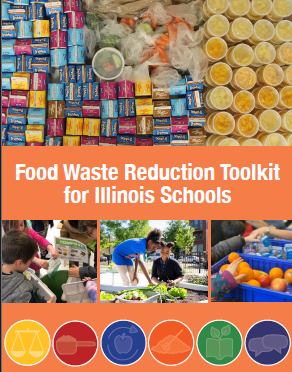
After the GLC project ended, I was fortunate to become involved in the Wasted Food Action Alliance (WFAA), an IL-based coalition of organizations helping to build a unified approach towards reducing wasted food and leveraging it to benefit our region. One of the early WFAA projects I was involved with was a committee to create a toolkit for K-12 schools to reduce food waste. The result was the Food Waste Reduction Toolkit for Illinois Schools, available for download at https://wastedfoodaction.org/school-toolkit/. As described on the WFAA site, the toolkit is “a comprehensive resource that provides all schools, no matter their size or location, the tools to tackle the issue of wasted food. It identifies the main sources of wasted food and offers strategies for food waste prevention, recovery and redistribution, composting, education and engagement, and celebrating success. A variety of solutions are shared–from easy and quick to implement to longer term and more resource intensive.” Though the toolkit is several years old now (it was first published in 2020 and updated in 2022), the strategies outlined in it, like those in the GLC suggested activities, are still viable.
If you represent an IL K-12 school, these two older resources are great places to start your exploration of food waste reduction, and provide a lot of inspiration.
Seven Generations Ahead: Zero Waste Schools
Seven Generations Ahead is a non-profit based in Oak Park, IL, which I’ve had the privilege of working with frequently throughout my career. Their staff are among the founders of the Illinois Food Scrap and Composting Coalition, which I’ve been a member of for many years, and they were a driving force behind the formation of the Wasted Food Action Alliance. Their zero waste efforts overlapped a lot with those of the ISTC Technical Assistance Program (TAP), which I was part of for several years, though ISTC tended to work more with larger companies, manufacturers, and institutions and governments throughout the state, plus, our TAP program provided pollution prevention and other expertise. SGA has always tended to be more community based in my mind, so they don’t tend to work with large manufacturers, for instance, and their work is centered in the greater Chicago area. ISTC collaborated with SGA on projects during my tenure there, and my current employer, the EnergySense Resilience Center (which is part of the University of Illinois System) also crosses paths with them frequently. They’re among the ‘usual crew’ of good human beings who are always at work trying to make our state–and-planet–a better place. Among the good work that SGA does is their exemplary Zero Waste Schools Program. The program has helped over 70 schools launch zero waste programs, and as result they estimate their program has helped keep 561 tons of waste out of landfills annually.
If you represent a school in the greater Chicago metro area and you haven’t yet reached out to SGA for assistance, start your school year off right and do so now! If you’re not quite ready to start a zero waste program, or if you’re based elsewhere and just want to learn about relevant resources and case studies first, sign up for their Zero Waste Schools newsletter.
Updated Share Table Guidance
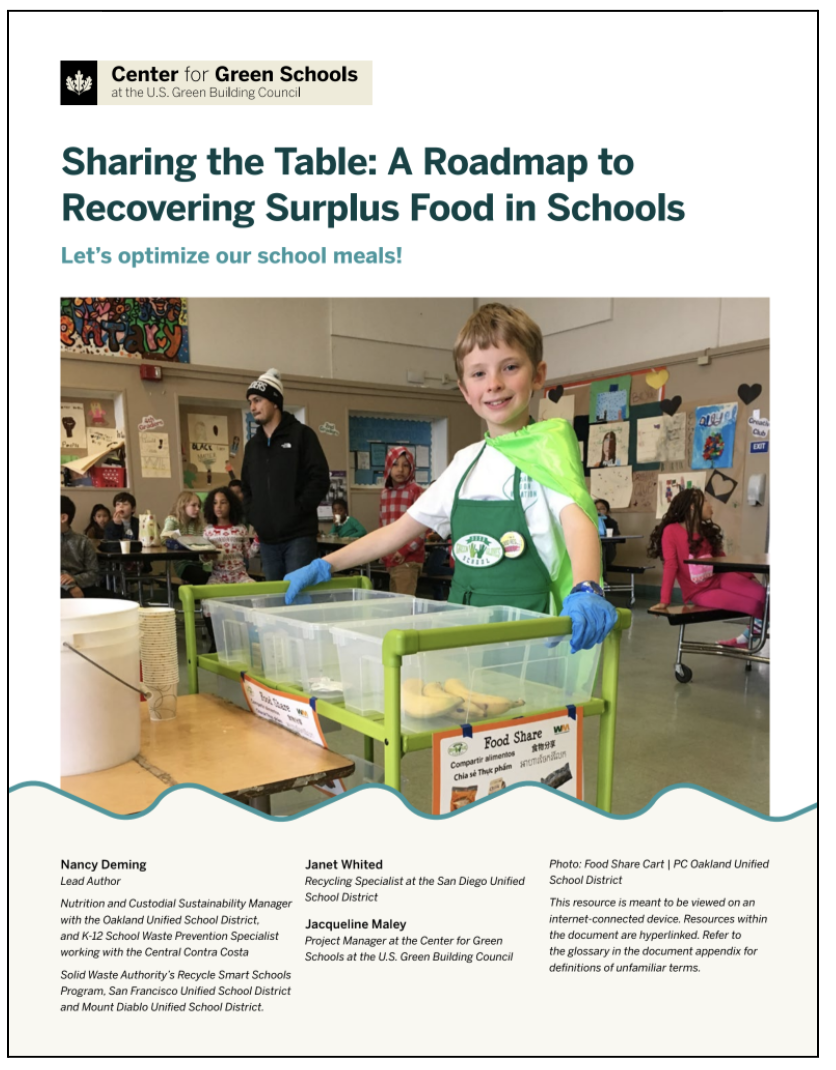
In July 2026, the US Green Building Council’s Center for Green Schools released an updated version of its guide, Sharing the Table: A Roadmap to Recovering Surplus Food in Schools. The guide was originally published in 2019, and the updated version “highlights new research, policies, and best practices for optimizing food waste and recovering surplus food from school meals.” The publication provides guidance on setting up share tables–tables (or carts) that allow students to place unwanted, unopened food and drink aside for others to consume. It also provides guidance on collecting surplus food prepared for students for redistribution to community programs addressing food insecurity. The folks who work in school food service want the food they work hard to prepare to nourish children, or to nourish someone who needs it. It truly is a crime against humanity and nature to let such food go to waste, and this resource can help you prevent that at your school or district. You can download the guide at https://www.usgbc.org/resources/sharing-table-roadmap-recovering-surplus-food-schools.
Food Waste Prevention Week & Student Poster Contest
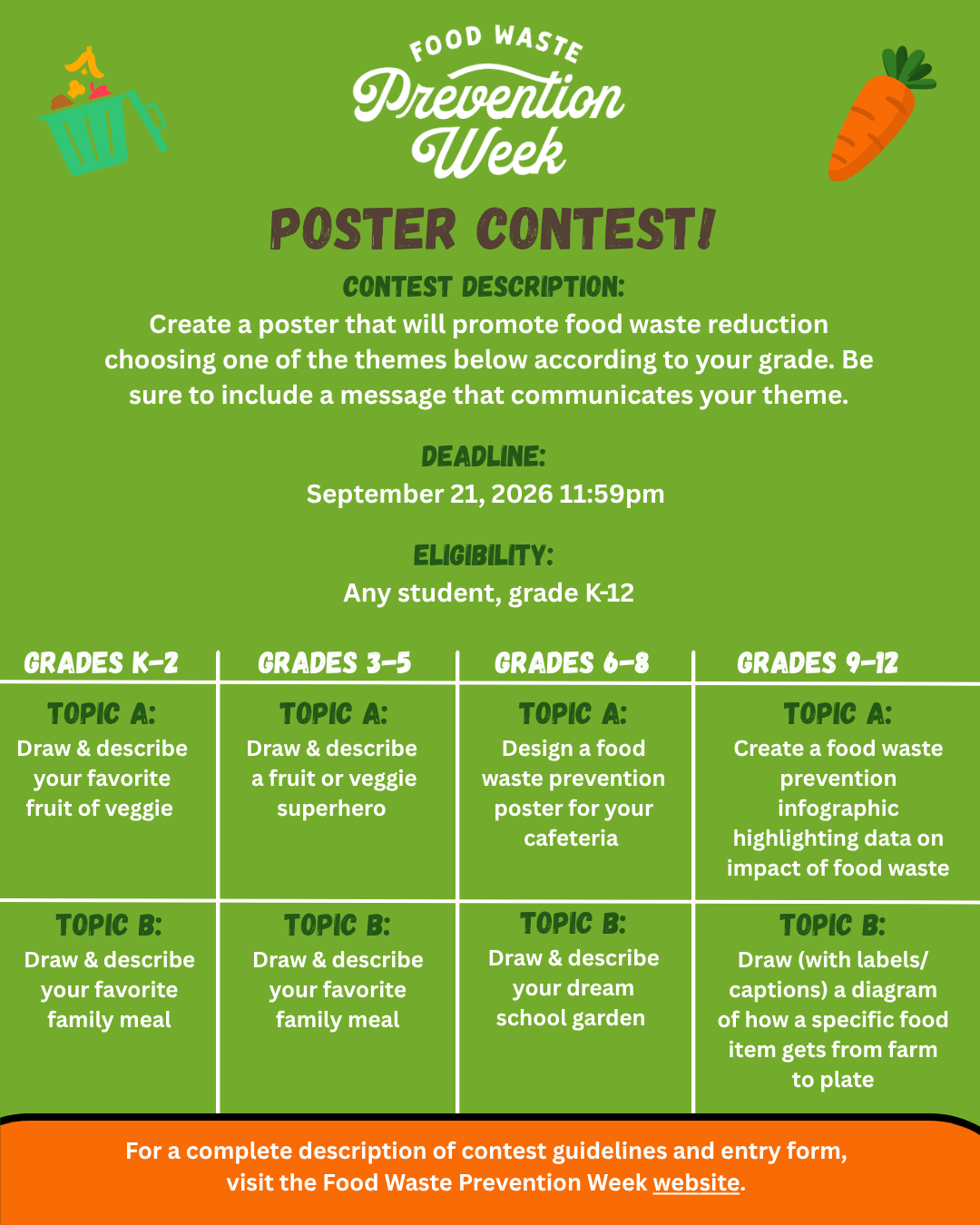
Finally, I want to tell you about Food Waste Prevention Week, an annual event focused on raising awareness of food waste and ways to reduce it. For the past several years, the event took place in April, which was a busy time for environmental advocates because of Earth Day. So, this year, it’s been shifted to Sept. 28-Oct. 4. Your school or district can sign up to be a partner, if desired. Some partners host webinars during the week (like this one coordinated by the folks at the Wasted Food Action Alliance and SGA, scheduled for Sept. 28), while others stick to sharing relevant information via social media and other forms of media. During my tenure at ISTC, we signed up to be a partner multiple times (maybe 3?) over the last few years, and this year, I’m pleased that EnergySense Resilience Center has signed up. The event can be a great way to engage students, families, and staff in thinking about food waste issues and potential solutions, or it can be a good way for passionate teachers, staff, or student groups to learn more and gather inspiration to make positive change at their school. See https://foodwastepreventionweek.com/k-12-schools/. Mark your calendars, and in the meantime, check out their K-12 student poster contest: https://foodwastepreventionweek.com/k-12-student-art-contest/. What a great activity to foster creativity and environmental stewardship among your students!
I hope these resources help your school, district, or youth group reduce food waste! Let’s feed people, not landfills!

