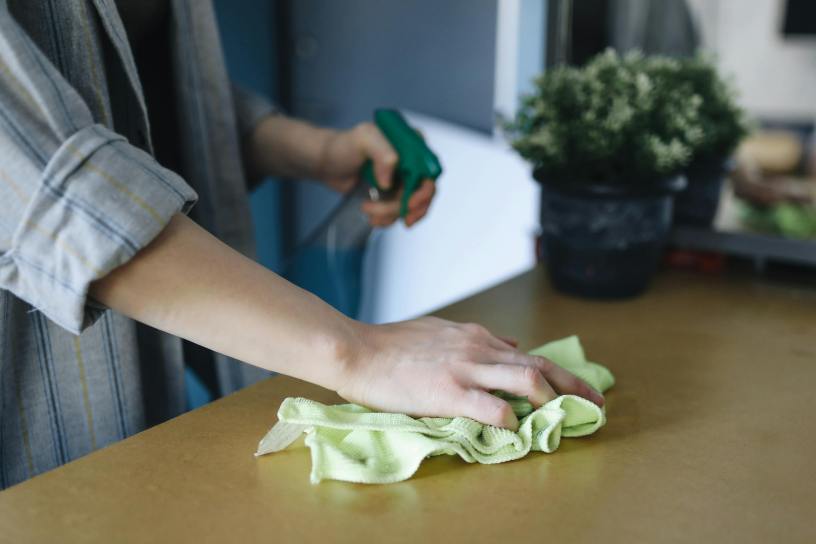
Back when I worked on the Great Lakes Regional Pollution Prevention Roundtable (GLRPPR, the project I was hired for at the Illinois Sustainable Technology Center, or ISTC, over 23 years ago), I learned about Stephen Ashkin, the so-called “Father of Green Cleaning,” and frequently shared green cleaning resources from Ashkin with GLRPPR members. Ashkin is the President of The Ashkin Group, LLC, a green cleaning consulting firm. I have to admit to feeling a wave of nostalgia recently when seeing a post from Steve on LinkedIn, thinking of the good ‘ol days working on GLRPPR. As I read however, that wave of nostalgia was replaced by a wave of nausea, since Steve’s post focused on yet another way people are exposed to microplastic pollution. Namely, microfiber cloths. This wasn’t news to me; I’ve posted previously on the ISTC blog on tips for reducing plastic pollution from clothing and textiles. But I wanted to amplify Steve’s message during Plastic Free July, since the notion of plastic pollution from textiles might be news to some folks.
According to the United Nations Environment Programme (UNEP), about 60% of material made into clothing is plastic, including polyester, acrylic, and nylon textiles. Normal wear and tear through everyday use, and yes, through laundering, causes our clothing to shed fibers–something you realize if you’ve ever emptied a dryer’s lint trap. When your washing machine drains at the end of a cycle, it doesn’t just whisk away dirt and grime, but also some of those microfibers, many of which represent a form of microplastics. UNEP estimates that textiles contribute 9% of microplastic losses to our oceans, though I’ve seen other sources claim their contribution is anywhere between 15 and 31% of microplastics entering oceans. This reality is why some governments are passing or proposing legislation to require filters on new washing machines to keep these microplastics from entering our waterways. France, for example, became the first country to require microfiber filters to be integrated into new washing machines, effective January 2025. California, New York, and Illinois have considered similar legislation at the state level in the USA, and Senator Merkley of Oregon introduced similar legislation at the federal level in 2024.
Steve’s LinkedIn post highlighted an article he wrote with Allen Rathey for CleanLink about the potential negative impacts of microfiber cloth use: https://www.cleanlink.com/cleanlinkminute/details/Environmental-Side-Effects-of-Microfiber–65844. Ashkin and Rathey state: “Microfiber products are typically made from synthetic materials — polyester and polyamide — that shed microscopic plastic fibers each time they are laundered. These fibers are too small to be captured by most wastewater treatment systems and ultimately end up in oceans, rivers, and even the air. While microfiber is often promoted as environmentally preferable because of its reusability and reduced need for cleaning chemicals, this narrative ignores its long-term impact on ecosystems and public health (inhaling or ingesting microfiber is associated with lung disease; airway problems; forms of cancer; liver, gut, and kidney ailments; and the smallest fibers may enter the bloodstream, placenta, brain and other tissues). Ironically, a product introduced to support green cleaning goals is now recognized as a key source of plastic pollution, highlighting the unintended environmental and public health costs of widespread microfiber use.”
Ah, unintended consequences, the result of so many human activities. The article goes on to highlight additional concerns related to microfiber cloths and expresses the need for the cleaning industry to assume responsibility for transparency, innovation, and accountability. Among the potential actions suggested by the authors is adding filters to washing machines to capture fibers shed by these cloths. They also point out the current lack of good reusable alternatives to microfiber cloths. Cloths made from natural fibers come with their own baggage due to the resources used for crop production, chemicals involved in manufacturing, and the potential need to use additional cleaning chemicals with these cloths as compared to microfiber cloths.
I recently shared this article with some colleagues who work on emerging contaminants, as part of a broader conversation about the hazards that workers from various sectors (cleaning, construction and demolition, etc.) may be exposed to as part of their normal activities. I was thinking of janitorial crews potentially inhaling microplastics while working with these cloths. When I returned to my desk later that day, I came across the following news item, which is related though somewhat tangential since it focuses on polystyrene particles: https://www.news-medical.net/news/20250715/Microplastics-found-to-trigger-cancer-linked-changes-in-lung-Cells.aspx. “Although the respiratory system is one of the main entry points for microplastics and nanoplastics (MNPs) from the air into the body, little is known about the effects of these tiny particles on the lungs. Researchers at MedUni Vienna have now demonstrated for the first time that MNPs can trigger malignant changes in lung cells that are associated with the development of cancer. The findings were published in the Journal of Hazardous Materials and once again underline the urgent need for action to reduce plastic waste.” See https://doi.org/10.1016/j.jhazmat.2025.139129 for the journal article referred to in that news piece. Again, this is somewhat tangential since it doesn’t involve the particles found in microfiber cloths, but it echoes the point from the Ashkin and Rathey article: “this narrative ignores its long-term impact on ecosystems and public health (inhaling or ingesting microfiber is associated with lung disease; airway problems; forms of cancer; liver, gut, and kidney ailments”.
So am I trying to tell you to stop using microfiber cloths? No. I’m just sharing with you that plastic pollution isn’t just about water bottles, food packaging, and disposable straws and cutlery. As a society, we’ve integrated plastics into so many products that it’s virtually impossible to rid our lives of plastics. The best we can do at this point is to avoid it whenever we can, however we can, and let manufacturers and legislators know that we care about this issue and expect products to be free of plastics whenever possible, and support regulations to prevent and control plastic pollution. If this feels frustrating, I agree, but remember that all of our actions have both positive and negative impacts. We can’t be perfect, but as we learn more about impacts, we can do what we can to minimize the negative and tilt the scales further toward the positive. Beyond that, here are some things you can do to reduce microfiber pollution.
- If you have microfiber cleaning cloths, be sure to maintain them properly. Taking care of them may minimize their release of microfibers. Check out this article from Real Simple: How to Clean a Microfiber Cloth Properly. They suggest not washing them with lint shedding materials, not using fabric softener, and drying them on low or air drying. I’d further suggest you wash with cold water only.
- As your microfiber cloths wear out, consider replacing them with natural fiber cloths repurposed from old clothing. These textiles have already been manufactured, so the resources used to create them have already been spent, and by repurposing, you’re keeping them out of the landfill. As I suggested in a recent ISTC blog post on reducing textile waste, you may wish to stitch the cut edges of the cloths to reduce fraying, or if you’re not good with a needle and thread, use pinking shears to cut the cloths.
- Because non-microfiber cloths may require the use of more cleaning solutions as compared to microfiber cloths, be sure to choose less toxic cleaners. If you’re dusting, consider just dampening your cloth with water to assist in picking up debris. Good ‘ol soap and water can be a fine choice for cleaning surfaces too. Beyond that, check out this guidance from Consumer Reports on How to Choose Nontoxic Cleaning Products.
- If you can afford to, consider adding an external filter to your washing machine. Companies like Filtrol, PlanetCare, and Environmental Enhancements offer external filters that can be attached to your existing washing machine.
- If you’re on a tighter budget, you might try using a Cora Ball or Guppy Friend washing bag inside your washing machine, but these will be less effective than the external filters and may involve other issues. For example, the Cora Ball might snag on certain items, and the Guppy Bag might not be big enough to house all the synthetic items you need to wash, requiring multiple loads.
- Use a HEPA air filter to reduce your exposure to airborne microplastics, and vacuum and wet mop regularly to reduce the amount of plastic particle-laden dust that might be kicked up into the air.
For additional guidance on reducing exposure to microplastics, see this article from Neha Pathak writing for Yale Climate Connections, “How to reduce microplastic exposure and protect your health.” For more on microfiber pollution, see “What You Should Know About Microfiber Pollution” from the US EPA.

 Joy-S-ness